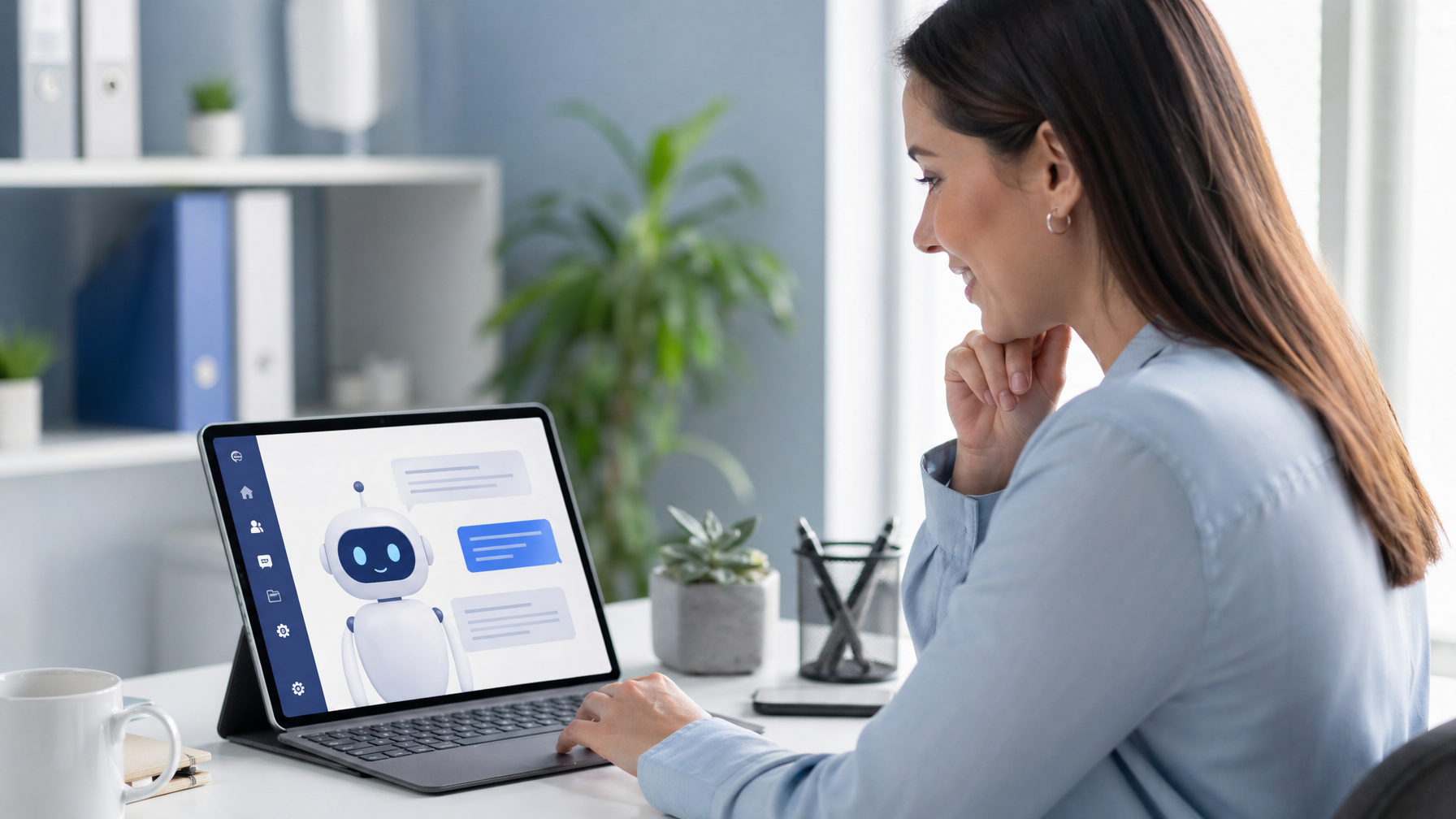
An AI onboarding assistant is a conversational AI tool that guides new employees from day one — answering HR, IT, and policy questions in real time, automating admin tasks, and personalizing the experience by role. Companies using AI onboarding retain 82% more new hires, cut onboarding time by up to 53%, and save over $18,000 annually. This guide covers how they work, what to look for, and how to calculate ROI before you buy.
An AI onboarding assistant is a secure, intelligent virtual assistant designed specifically to support new employees during the onboarding process. It answers questions, guides workflows, delivers policy information, and automates repetitive tasks — all through a conversational interface embedded in tools like Microsoft Teams, Slack, or a company intranet.
Unlike a static FAQ page or a shared document folder, an AI onboarding assistant responds to natural language questions in real time. A new hire who needs to know their parental leave policy, how to submit an IT ticket, or where to find their benefits enrollment form gets an instant, accurate answer — without waiting for an HR or IT team member to respond.
According to a 2026 study from Northern Kentucky University, 68% of new hires already used AI tools during their first 90 days to help them get up to speed. More revealing: 59% said AI filled gaps that their manager or HR team didn't cover. The behavior is already there. The question is whether organizations are channeling it through a governed, accurate, company-specific tool — or leaving employees to fend for themselves with generic AI tools. (Human Resources Director)
The gap between what onboarding promises and what it delivers is wide — and costly.
Four in five workers say a better onboarding process would encourage them to stay longer in their roles. Yet only 12% of employees report a positive onboarding experience with their employer. (AIHR, DianaHR)
Why the disconnect? Traditional onboarding struggles because:
The average employee isn't fully productive until their fifth or sixth month on the job. That "productivity tax" compounds fast across a workforce.
An AI onboarding assistant uses large language models (LLMs) combined with retrieval-augmented generation (RAG) to pull accurate, company-specific answers from your internal knowledge base. Here's the flow:
The key differentiator from a generic chatbot is that the AI onboarding assistant responds based on your company's actual policies — not generic internet content. This matters enormously for compliance, accuracy, and employee trust.
Not all AI onboarding assistants deliver the same capability. When evaluating options, prioritize these features:
The assistant should handle conversational, imprecise questions the way a real person would. "What's my PTO?" and "How many vacation days do I get?" should return the same answer.
Onboarding spans multiple departments. A new hire's first-week questions cut across HR (benefits, policies, payroll), IT (access, equipment, software), and Operations (processes, tools, compliance). Choose a platform that covers all three.
The assistant should live where employees already work — Microsoft Teams, Slack, or your HRIS. A tool that requires new hires to open a separate application will see low adoption.
Content and responses should adapt to the new hire's department, location, and seniority level. What a US-based manager needs to know on day one differs from what an EU-based individual contributor needs.
Global teams can't wait for business hours. Look for a platform that supports multiple languages and is always on — critical for international or shift-based workforces.
Onboarding involves sensitive data. The platform must be SOC II Type 2 certified, GDPR compliant, and support your data residency requirements. Check for role-based access controls and audit trails.
Which questions get asked most often? Where do new hires get stuck? A good AI onboarding assistant surfaces these insights so HR can proactively improve the experience.
New hires become fully productive 50% faster when AI supports their onboarding. For companies where it previously took 10-15 days to onboard employees, AI-assisted onboarding has cut that to under a week. Hitachi, for example, reduced HR workload per new hire from 20 hours to 12 hours after implementing AI onboarding. (iTacit)
Every new hire gets the same high-quality answer to every policy question — regardless of who their manager is, what time zone they're in, or how busy HR is that week. This consistency reduces compliance risk and eliminates the "it depends on who you ask" problem.
When an AI assistant answers the 50 most common new-hire questions automatically, the tickets that would have flooded HR and IT simply don't get created. Platforms like MeBeBot report a 68-80% reduction in repetitive support tickets after deployment.
A new hire in Singapore or São Paulo at 11pm can get their question answered immediately — without anyone working overtime. This is table-stakes for global enterprises.
AI can tailor the onboarding experience to each individual's role, location, and learning pace. A new sales hire gets sales tool walkthroughs and CRM training pathways. A new engineer gets development environment setup guides and architecture documentation. Neither waits for the other's content.
The connection between onboarding quality and retention is direct and well-documented:
Why does better onboarding retain people? Because the biggest driver of early attrition isn't pay or culture — it's confusion and feeling unsupported. When a new hire feels lost, overwhelmed, or unable to get answers, they disengage. When they have a knowledgeable guide available the moment they need it, they build confidence faster and connect to the organization more deeply.
The first 90 days are when impressions form and decisions about whether to stay get made. An AI onboarding assistant makes those 90 days feel supported, organized, and personalized — all at once.
The ROI case for an AI onboarding assistant comes from four areas:
ROI DriverImpactReduced HR/IT ticket volume68-80% fewer repetitive support requestsFaster time-to-productivityNew hires reach full output 50% soonerLower early attritionUp to 82% improvement in new hire retentionAdministrative savings$18,000+ saved annually per organization
To calculate your own ROI, start with what you currently spend on:
For mid-size enterprises onboarding 50+ new hires per year, the numbers move fast. A platform like MeBeBot reports a 200%+ ROI for customers — driven primarily by ticket deflection and retention improvement.
Use this checklist when evaluating platforms:
Functionality
Integration
Security
Accuracy and Reliability
Support and Scalability
A useful rule: avoid platforms that pitch onboarding as a side feature. The best AI onboarding assistants are purpose-built for the employee support use case — not repurposed customer service bots.
MeBeBot is an AI platform purpose-built for employee support across HR, IT, and Operations. For HR teams focused on reducing the friction of the first 90 days, it delivers:
MeBeBot's PEPM (per employee per month) pricing model keeps costs predictable and directly tied to your headcount — with no hidden implementation fees. It's designed for mid-market and enterprise organizations that want a measurable, scalable onboarding solution without a year-long IT project.
For a deeper look at how AI assistants change the new hire experience day by day, read: How AI Assistants Improve Employee Onboarding.
The onboarding window is short and its impact is long-lasting. Companies that get it right see faster productivity, stronger retention, and lower HR overhead. Companies that don't see 20% of new hires walk out the door within 45 days.
An AI onboarding assistant closes the gap between what HR teams can realistically deliver and what new hires actually need — instant, accurate, personalized support from day one through the first 90 days and beyond.
The data is clear: 68% of organizations have already incorporated AI into onboarding. The remaining 32% are competing for talent with one hand tied behind their back.
Ready to see what an AI onboarding assistant looks like inside your organization? Book a FREE Demo with us and let your next new hire experience the difference.
Sources: AIHR | iTacit | Human Resources Director | DianaHR | Glitter AI | Everworker
.png)
.png)
.png)


.svg)


.svg)
.svg)