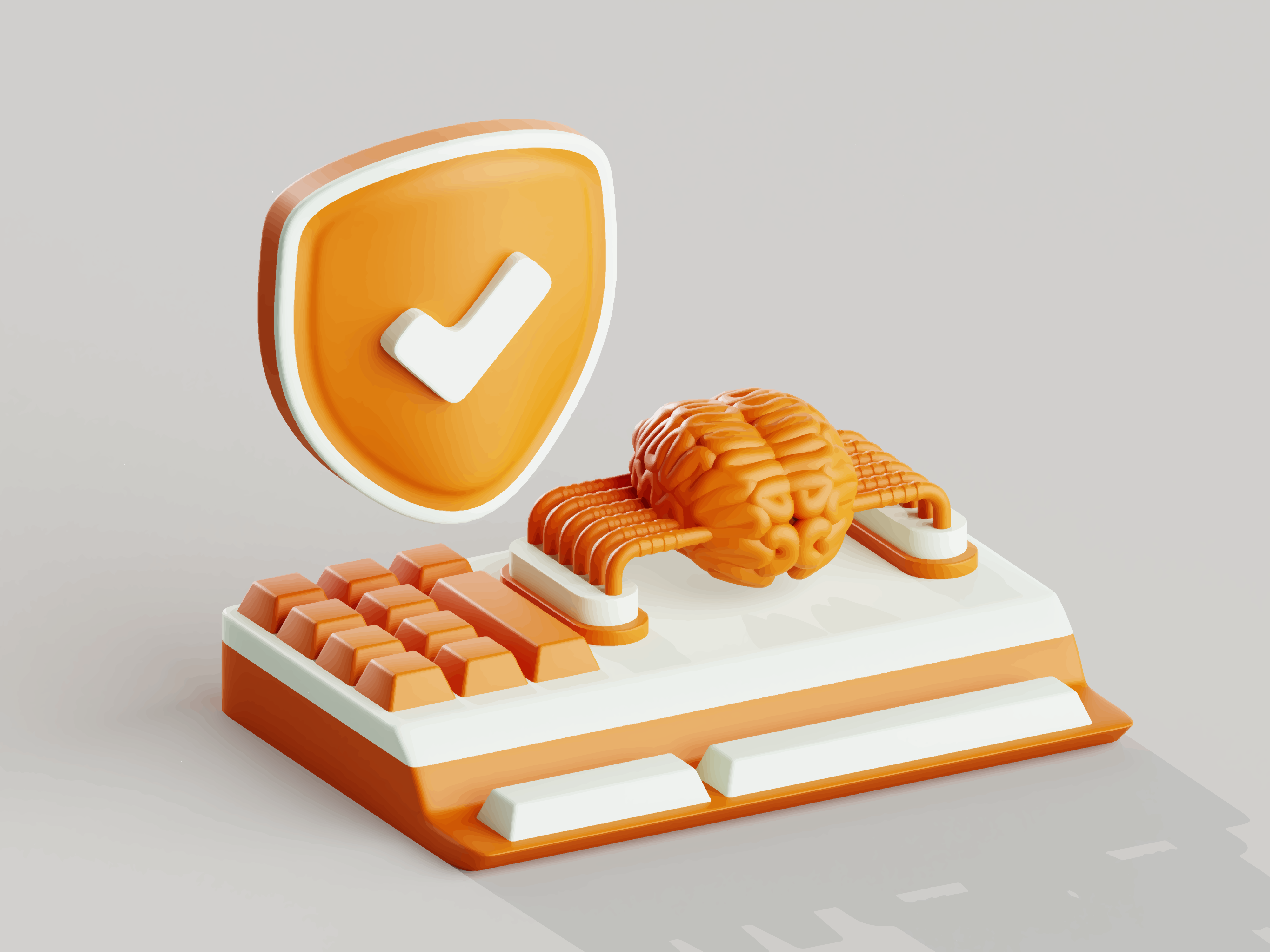
To ensure SOC2 and GDPR compliance, an AI system must meet what security leaders increasingly refer to as the Governance Triangle: Accuracy, Auditability, and Access Control. Unlike generic LLMs that generate unpredictable responses, a solution like MeBeBot uses prescriptive answers, Verified AI, and RAG grounding to ensure nothing is fabricated, every answer is traceable, and all data access is role-based. This protects employees, reduces legal exposure, and ensures that HR information is consistently delivered without violating privacy or compliance requirements.
Most generative AI tools were not built for HR or compliance-heavy environments. They were trained on vast amounts of unknown data, and the internal logic that generates answers is not transparent. For CIOs, CISOs, and CHROs, this creates three immediate risks:
Hallucinations
If an AI invents policy details, like a leave of absence policy or a harassment reporting step, or benefits eligibility, the organization becomes liable for the bad information employees rely on.
Untraceable Answers
If your legal team can’t see where an answer came from or why the AI responded a certain way, you can’t audit it. That violates many SOC2 controls and raises GDPR concerns around data integrity.
Data Leakage
Sending HR questions or internal policies to public LLMs may inadvertently expose sensitive data, especially risky for global organizations managing EU employee information.
For HR, even a small error can create a big problem.
An invented payroll process can trigger financial mistakes, a misinterpreted leave policy can violate labor laws, and inaccurate harassment guidance can expose the company to litigation.
This is why the era of “Black Box AI” is incompatible with enterprise HR.
To safely automate HR and IT answers, organizations need AI that is fully governed, not generative guesswork. The Governance Triangle provides the framework for evaluating whether your AI meets SOC2 and GDPR expectations.
Accuracy (RAG Grounding)
Accurate AI must pull answers from your documents, your policies, and your approved content. That’s why RAG is essential. It ensures the AI retrieves exact policy language before answering, eliminating hallucination risk.
AI should not be “creative.” It should be consistent.
Auditability (Complete Logs for Legal Review)
SOC2 and GDPR require traceability, meaning there needs to be an understanding of how information flows from an employee to a solution, and back to the employee. It is key to ensure:
Audit trails allow HR and legal teams to verify correctness, investigate disputes, and prove compliance.
Without logging, you cannot verify data integrity, the core of GDPR.
Access Control (RBAC and Data Minimization)
A compliant AI must respect employee permissions.
That means:
Role-Based Access Control (RBAC) ensures employees only see what they are authorized to see, preventing accidental disclosure of restricted information.
The Governance Triangle ensures AI behaves predictably, safely, and in alignment with enterprise compliance standards.
Most HR leaders don’t want AI to “think.” They want it to be right.
This is why the industry is shifting toward Prescriptive AI: structured, validated answers instead of open-ended generation.
Prescriptive AI
It is the equivalent of a “trusted knowledge engine.”
Generative AI
In high-stakes HR environments, leave policies, payroll rules, disciplinary processes, precision is everything.
A Hybrid model, with both Generative AI and Prescriptive AI is not only safer; it is more scalable. Your HR team maintains control of the content, and the AI becomes a reliable extension of your policies, not a wildcard.
Does MeBeBot share customer data with public AI models?
No. MeBeBot operates within a secure, private environment and does not expose customer data to public model training. Customer content is stored in an access-controlled infrastructure, and all processing occurs within MeBeBot’s governed platform. This means your HR, IT, Payroll, and policy information stays fully isolated within your own customer private data model and tenant.
What is the difference between prescriptive and generative AI?
Generative AI creates answers by predicting the next most likely words, which can introduce risk, if not properly grounded.
Prescriptive AI, which MeBeBot customers can use, retrieves validated, admin-approved responses from your knowledge sources. This ensures the AI delivers consistent, accurate, and compliant answers every time.
MeBeBot also uses a hybrid AI approach internally, where employee answers are always grounded in curated and verified content, not open-ended generation.
Is MeBeBot’s AI platform secure for enterprise data?
Yes. MeBeBot follows SOC 2–Type 2security practices, including encryption in transit and at rest, role-based access controls, secure development processes, regular penetration testing, and continuous monitoring. All responses are logged for auditability, and customer-specific content is handled according to GDPR-aligned privacy standards.
For customers who require formal verification, MeBeBot’s SOC 2 audit report is available upon request.
.png)
.png)
.png)


.svg)


.svg)
.svg)